I Used a Free AI as a Price Comparison Tool for My Weekly Shop — Here’s What Actually Saved Money
Can a free AI chatbot actually save you money on your weekly grocery shop? I tested it over three weeks with real receipts. Here’s what worked, what didn’t, and the specific prompts that found genuine savings.
There’s a version of this article that tells you AI is going to revolutionise how you shop and you’ll save hundreds of pounds overnight. This isn’t that article.
What actually happened when I spent a few weeks testing free AI chatbots as a grocery price comparison tool was more nuanced — some things worked better than expected, some things were a complete waste of time, and the overall result was genuinely useful but in a more specific way than most people assume.
If you’ve wondered whether there’s a smarter way to stop overpaying on the same items you buy every single week, the honest answer is: yes, and free AI is part of it. But the part it helps with isn’t the part most people think.
🛒 Quick Summary: AI as a Price Comparison Tool
- What this is: An honest, first-person account of testing a free AI chatbot as a grocery price comparison tool — including what worked and what didn’t.
- Who it helps: Anyone who suspects they’re overpaying on their weekly shop but doesn’t have time to compare prices across stores manually.
- Problem it solves: Supermarkets make unit price comparison deliberately confusing. Free AI can do that maths for you in seconds — if you know how to ask.
- Main takeaway: AI can’t check live prices, but it’s genuinely useful for unit price reasoning, own-brand comparisons, and identifying where you’re overpaying on repeat purchases.
- What to do next: Take your last grocery receipt and try the test prompt in this article — paste in three versions of something you buy every week and ask AI to rank them by value.
- Why it matters: UK households spend an average of over £4,500 a year on groceries. Even a 5% reduction from smarter comparison adds up to over £200 saved annually.
What I Actually Did — The Test Setup
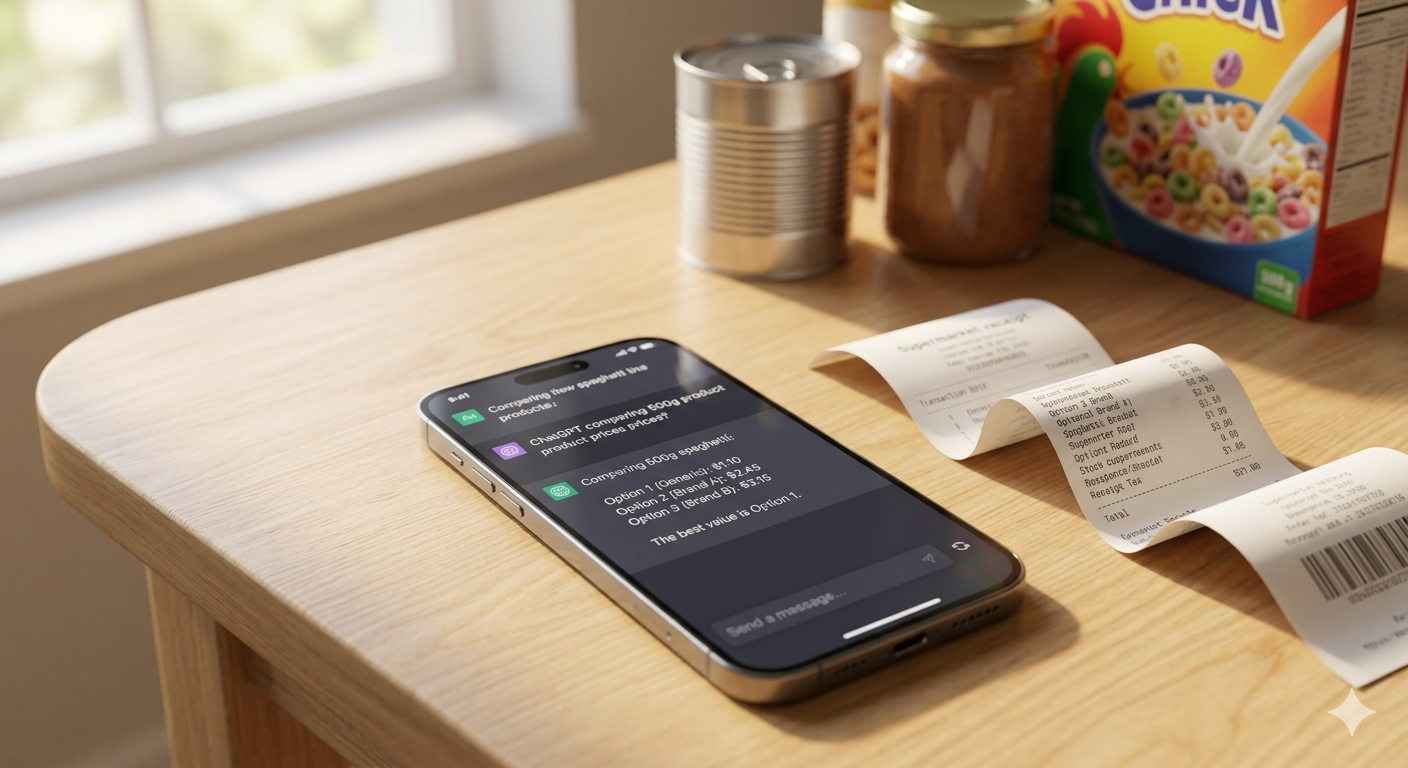
Over three weeks, I used the free tiers of ChatGPT and Google Gemini as price comparison tools for my weekly grocery shopping. I didn’t use any paid subscriptions. I didn’t use any specialist price-comparison apps. Just the AI chatbots that anyone can access for free, and my actual shopping receipts.
The approach changed as I went. In week one, I tried asking AI broad questions about supermarket prices. In week two, I got more specific — pasting in actual product details and asking for unit price comparisons. In week three, I refined the approach further and focused only on the categories where it was producing the clearest results.
Here’s what I found.
The First Thing I Got Wrong
My first test was straightforward: I asked the AI to tell me which supermarket had the cheapest own-brand olive oil this week.
The response was confident, detailed, and almost entirely useless for my actual shopping trip.
The problem is that free AI tools are not connected to live supermarket databases. They don’t have access to current prices in real time. Their knowledge comes from training data with a cutoff date — which means any specific price they quote for a specific product at a specific store could be weeks, months, or longer out of date.
This is where a lot of people get frustrated and dismiss the tool entirely. They ask for live price data, get confident-sounding but unreliable figures, and conclude AI is useless for shopping.
That conclusion is wrong — but it requires understanding what AI is actually good at before you can use it well.
What AI Cannot Do (So You Stop Asking It To)
Before covering what works, it’s worth being clear about the boundaries.
| Task | Can free AI do this? | What to use instead |
|---|---|---|
| Check today’s prices at your local Tesco | No | Tesco app / website |
| Find this week’s supermarket deals and offers | No | Supermarket apps, Trolley.co.uk |
| Tell you which store is cheapest right now | No | Google Shopping, store websites |
| Compare unit prices when you give it the numbers | Yes — accurately | AI is ideal |
| Suggest which product format typically offers better value | Yes — reliably | AI is ideal |
| Identify own-brand alternatives to branded products | Yes — well | AI is good at this |
| Rank options by price-per-unit when you provide prices | Yes — instantly | AI is ideal |
| Explain why a bigger pack isn’t always cheaper | Yes — clearly | AI is ideal |
The moment I stopped asking AI to do the things in the first column and started asking it to do the things in the second column, it became genuinely useful.
The Unit Price Problem That Supermarkets Create Deliberately
This is where free AI earns its place in a grocery shopping routine — and it’s something most people never think about until they see it clearly.
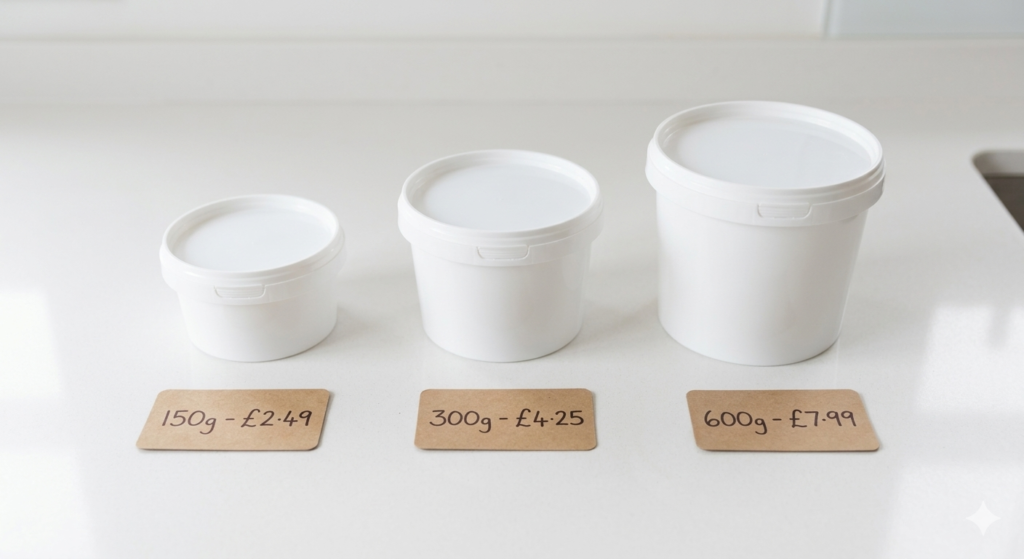
Supermarkets display unit prices inconsistently, and this isn’t accidental. On the same shelf, you might find:
- A 400g tin of tomatoes showing a price per 100g
- A 680g tin showing a price per kg
- A multipack of six showing a price per tin
To compare these three options properly, you’d need to convert them all into the same measurement and divide manually. Most people don’t do this in a supermarket aisle. They glance at the headline price, assume the bigger pack is better value, and move on.
Supermarkets know this. Price-per-unit inconsistency is structural — it creates the cognitive conditions for paying more than you need to.
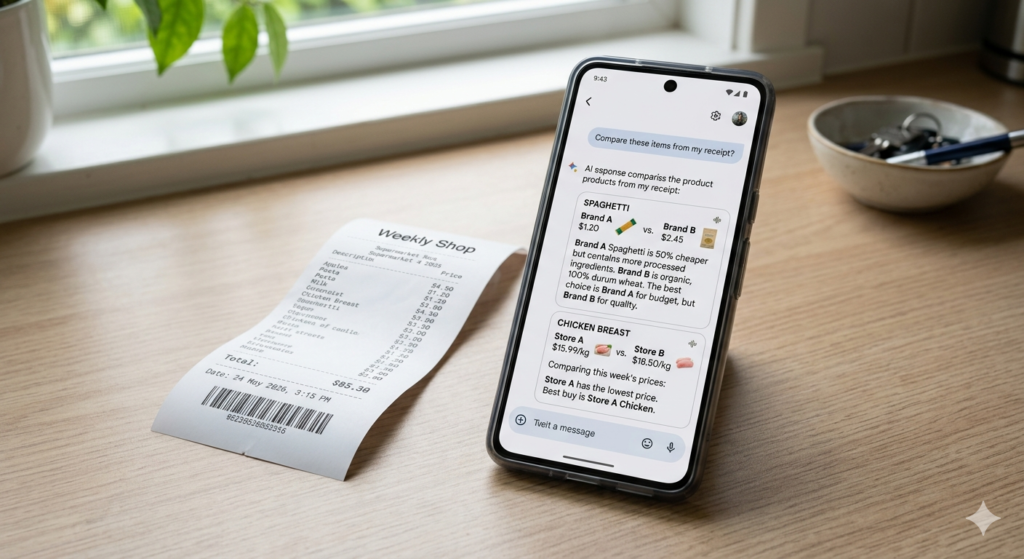
Here’s what AI can do about it. I pasted the following into the free ChatGPT interface:
“I’m comparing three yoghurt options. Option A is 500g for £1.10. Option B is 1kg for £1.95. Option C is a 6-pack of 150g pots for £3.20. Please calculate the price per 100g for each and rank them from cheapest to most expensive.”
The response came back in seconds:
- Option A: 22p per 100g
- Option B: 19.5p per 100g
- Option C: 35.6p per 100g
The 6-pack of individual pots — which looked like reasonable value as an easy grab — was nearly twice the cost per gram of the 1kg tub. I had been buying the 6-pack for months because it felt convenient and looked competitively priced.
That one calculation was worth more than ten minutes of in-aisle squinting.
What Happened When I Tested AI Against My Actual Receipt
In week two, I took a real receipt from the previous week’s shop and typed out the ten most expensive items. I asked the AI two questions for each one:
- “Is there typically a meaningful difference in quality between the branded version and an own-brand equivalent for this product?”
- “Based on typical pricing patterns, which format or size usually offers the best value for this type of product?”
I want to be honest about the results, because inflating them would make this article useless.
Where AI was genuinely helpful:
Cooking oil: AI correctly identified that for everyday cooking (not dressings or finishing), there’s no practical flavour difference between supermarket own-brand light olive oil and branded versions costing 40–60% more. I switched. That one change saves roughly £1.20–£1.50 per bottle.
Breakfast cereal: AI flagged that branded cornflakes and own-brand cornflakes are often produced in the same facilities, and that the primary difference is packaging. I tested the own-brand. There was no perceptible difference. Saving: about 70p per box, and I buy two per month.
Tinned tomatoes: AI noted that chopped tinned tomatoes are one of the products where own-brand versions consistently test as comparable to branded in blind taste tests. I’d been buying branded out of habit. Switching saves roughly 25–35p per tin, and I use three to four a month.
Cleaning products: AI was clear that washing-up liquid, multipurpose spray, and many cleaning products have significant branded premiums with no performance advantage for everyday household use. This one I already knew, but the AI reinforced it clearly.
Where AI was not helpful:
Fresh produce: AI gave me general guidance (“seasonal vegetables are usually cheapest”) but couldn’t tell me whether the courgettes were cheaper at my local supermarket this week or the one three streets away. This is a live-data problem and AI simply can’t solve it.
Fresh meat: The AI’s suggestions for cheaper alternatives to what I usually buy weren’t wrong, exactly, but they involved substituting cuts in ways that didn’t account for how I was cooking them. A recipe built around chicken thighs doesn’t translate automatically to turkey mince just because it’s cheaper per kilogram.
Ready meals: AI tried to help here but the comparison got complicated quickly — different portion sizes, different ingredient quality, different levels of convenience. I abandoned this category.
The honest total for one week: Based on the switches I made and maintained, my ongoing weekly saving from AI-informed product switching runs to roughly £3.50–£5.00 per shop. That doesn’t sound dramatic. Over a year it’s £180–£260 — which is real money for changes that took about twenty minutes to identify and zero additional effort to maintain.
The Five Categories Worth Using AI For — and Three That Waste Your Time
Not every product category is worth the effort of an AI comparison. Here’s what the testing showed:
| Category | Worth using AI comparison? | Why |
|---|---|---|
| Cooking oils | Yes — high value | Large price variation, no quality difference at everyday level |
| Breakfast cereals | Yes | Significant branded premium, own-brand often identical |
| Tinned goods | Yes | Consistent own-brand quality, high purchase frequency |
| Dairy basics (butter, cheese, milk) | Yes — especially cheese | Wide format and brand variation on cheese in particular |
| Cleaning and laundry products | Yes | Branded premiums are very high, performance differences minimal |
| Pasta, rice, oats | Occasionally | Prices are fairly stable; worth checking format/size |
| Fresh fruit and vegetables | No | Too seasonal and location-variable for AI to assess reliably |
| Fresh meat and fish | No | Quality, cut, and source variation makes pure price comparison too crude |
| Ready meals | No | Portion size, ingredient quality, and convenience factors make AI comparison unreliable |
The 80/20 principle applies here: focus AI comparison on your five to eight highest-frequency, highest-cost staples. Get those right once and you’re done — there’s no need to run comparisons every week on products that don’t change.
How to Actually Use Free AI for Price Comparison: The Prompts That Work
Based on the testing, these are the prompt structures that consistently produced useful results.
For unit price comparison:
“I’m comparing [product type]. Option A is [weight] for [price]. Option B is [weight] for [price]. Option C is [weight] for [price]. Please calculate the price per [100g / litre / unit] for each and tell me which is best value.”
For own-brand vs. branded assessment:
“For everyday household use, is there typically a meaningful quality difference between branded [product] and supermarket own-brand versions? I’m not looking for premium quality — just whether the cheaper option is genuinely comparable for normal use.”
For format and size guidance:
“I buy [product] regularly. The options available are usually [list sizes/formats]. Which format typically offers the best price-per-unit value, and are there any cases where a smaller size is better value than the larger one?”
For finding your highest-saving opportunities:
“Here are the ten items I spend the most on in a typical weekly shop: [list]. Based on general supermarket pricing patterns, which of these are most likely to have significant own-brand or format alternatives that could reduce my spend without reducing quality for everyday use?”
That last prompt is particularly useful as a starting point. It ranks the opportunities rather than leaving you to guess where to focus.
Cost-Saving Reality
The honest picture is this: AI price comparison is not a shortcut to a dramatically lower grocery bill. It’s a tool that helps you make better decisions about the specific products where branded premiums or poor format choices are quietly inflating your spend.
For a household that currently shops without much thought about own-brand alternatives or unit pricing, the savings from a focused AI comparison session can be meaningful — easily £150–£300 per year in sustained product switches across oils, cereals, tinned goods, and cleaning products.
For a household that already buys own-brand across most categories and pays attention to unit prices, the marginal gain from adding AI to the process is smaller — maybe £50–£100 per year in optimising the decisions they were already making reasonably well.
The tool is most valuable to the first type of household. If you’ve never really interrogated your weekly shop at a product level, a single AI comparison session for your ten highest-cost staples will likely find you two or three clear switches that pay off every week from that point forward.
If you want to take the budgeting side further, combining this approach with using a free AI to build a weekly grocery list that never goes over budget gives you both sides of the equation: what to buy and how much to spend on it.
Common Mistakes to Avoid
Asking AI for live prices. As covered above, this is the most common mistake and the source of most disappointment. Free AI tools cannot tell you what anything costs at your supermarket this week. Use them for reasoning and unit price maths — not as a real-time price database.
Applying the comparison to everything at once. Trying to AI-compare your entire weekly shop in one session produces information overload and diminishing returns. Start with five items. Find the best switches. Implement them. Then come back for five more.
Trusting AI suggestions about fresh produce quality. AI can tell you that organic carrots typically cost more than conventional ones, but it can’t tell you whether the quality difference justifies the premium at your specific store this week. Fresh food comparison requires in-person judgement.
Switching products without testing them. AI might correctly identify a cheaper alternative, but whether your household will actually eat it is a different question. Test own-brand switches with one pack before committing to them permanently — especially for things like pasta, cereal, and condiments where personal preference varies considerably.
Expecting the savings to be dramatic. A £3–£5 weekly saving from product switches sounds modest. It’s roughly £200 per year of genuine, sustained reduction in spending — from twenty minutes of AI prompting done once. That’s a reasonable return. Expecting more leads to discarding a tool that’s quietly working well.
Myth vs Reality
Myth: AI can tell you which supermarket is cheapest for your weekly shop. Reality: Free AI tools don’t have access to live supermarket pricing. For live price comparison across stores, dedicated tools like Trolley.co.uk or individual supermarket apps are what you actually need. AI is for reasoning about value, not for real-time data retrieval.
Myth: Bigger packs are always better value. Reality: This is one of the most common and consistently wrong assumptions in grocery shopping. AI testing regularly reveals that mid-size packs offer better price-per-unit than the largest option available — especially in product categories like yoghurt, cooking oil, and cleaning products where supermarkets price aggressively at the impulse-buy size. Never assume without checking.
Myth: Own-brand products are noticeably lower quality. Reality: For a significant range of everyday staples — cooking oils, tinned goods, dried pasta, cleaning products, cereals — supermarket own-brand versions are produced to comparable specifications as branded alternatives, and in some categories are produced in the same facilities. The quality assumption that justifies branded premiums is often a habit rather than a reality.
Myth: You need a paid AI subscription for this to work. Reality: The free tiers of ChatGPT, Google Gemini, and Microsoft Copilot handle unit price calculation and product comparison reasoning perfectly well. The task doesn’t require the enhanced capabilities of paid versions. This is a straightforward maths and reasoning task that free tools handle reliably.
Myth: This takes too long to be worth it. Reality: The initial setup — identifying your five to ten highest-cost staples and running comparisons on them — takes twenty to thirty minutes once. After that, maintaining your best-value choices requires no ongoing effort beyond occasionally checking whether a benchmark has shifted. The time investment is front-loaded and small.
Advanced Section: Building a Personal Price Intelligence System That Gets Smarter Over Time
For readers who want more than one-off comparisons, the long-term payoff comes from building a lightweight personal reference system that improves with each use.
Start with a benchmark list. After your first AI comparison session, save the results somewhere accessible — a note in your phone works well. Record the specific product, size, and approximate price-per-unit for the best-value option in each category you compared. This becomes your baseline.
The format is simple:
- Olive oil: own-brand 750ml / best value format — check price per 100ml vs. current alternatives every 4–6 weeks
- Breakfast cereal: own-brand cornflakes / price per 100g benchmark — usually stable, check seasonally
- Tinned tomatoes: own-brand 400g tins / price per tin — rarely changes
Update the benchmark rather than starting from scratch. When you do return to a category, don’t treat it as a fresh comparison. Give the AI the context: “My current best-value olive oil is the own-brand 750ml at approximately Xp per 100ml. Here are three options currently available. Has the best-value option changed?” This is faster than starting over and produces more targeted results.
Use AI to find your household’s highest-cost-per-use items. This is a different question from highest ticket price. A product you use heavily at moderate price may cost more annually than a product with a high unit price that you use rarely. Ask the AI: “Based on these products and roughly how often I use them, which represent my highest annual food spend and therefore my highest savings opportunity?” This reframes the comparison from per-unit price to annual household impact — where the real money sits.
Build a rotation staples list. After two months of consistent AI comparison, ask the AI directly: “Based on these comparisons, what are the ten pantry staples that give my household the best value-per-use and should always be kept stocked?” This connects directly to the pantry meal planning approach in how to plan a whole week of meals from your existing pantry — where knowing your best-value staples feeds directly into more efficient meal planning.
Know when the system is working and you can stop actively managing it. The goal isn’t perpetual price comparison. It’s building a stable set of purchasing decisions that you’ve made deliberately and don’t need to keep revisiting. Once your benchmark list is established and your main product switches are in place, maintaining it takes five minutes a month — not five minutes every shop.
This kind of systematic approach connects naturally with the broader household savings framework. For readers also working on the energy side of their household bills, the same AI reasoning tools can be applied to utility costs — something covered in detail in how to get a free AI to create an energy-saving morning routine from your utility bill. And if you want to take the subscription spending side of your household budget under the same scrutiny, the AI subscription cleanout audit applies exactly the same investigative approach to recurring charges.
FAQ
Q: Can I use free AI to compare prices at different supermarkets for the same shop? A: Not for live prices — free AI tools don’t have access to current supermarket databases. For real-time cross-store comparison, Trolley.co.uk (UK) or similar price aggregator tools are the right choice. Where AI adds value is in the reasoning layer — understanding which product formats and categories typically offer better value, and doing unit price maths when you provide the numbers yourself.
Q: Is this useful if I already buy own-brand products for most things? A: Yes, but the gains are smaller. The highest-value use case for own-brand shoppers is unit price optimisation within own-brand ranges — making sure you’re buying the right size and format rather than just the right brand. AI is particularly useful for identifying cases where a mid-size pack is cheaper per unit than the large size, which happens more often than most people expect.
Q: How do I get the product details I need to give the AI accurate information? A: The easiest method is to do your shopping on a supermarket website or app, then copy the product names, weights, and prices directly from the product listings into your AI prompt. This takes about two minutes and produces far more accurate comparisons than trying to remember prices from an in-store visit.
Q: Will supermarkets change their pricing because people are using AI to compare? A: Supermarkets already know consumers compare prices and have structured their pricing to account for this. AI doesn’t change the competitive dynamics at a scale that would prompt a supermarket pricing response — it just helps individual shoppers navigate existing pricing more intelligently. The structural advantage is with the individual shopper, not the retailer, when unit price maths is applied consistently.
Q: I tried this and the AI gave me confident-sounding prices that were wrong. What happened? A: This is the live data problem described earlier in the article. The AI was drawing on its training data rather than current prices — which is a known limitation of free tools. The fix is to provide the current prices yourself and use the AI to reason about them, rather than asking it to retrieve prices independently. Once you make that shift, the outputs become reliable.
Conclusion
Free AI won’t transform your weekly shop overnight. But if you’ve been buying the same branded products out of habit, assuming bigger packs are always cheaper, and never really interrogating where your grocery money goes — a single AI comparison session for your ten most-purchased staples will find you real savings that continue every week without any additional effort.
The honest summary: AI is a reasoning tool, not a price database. Use it for unit price maths and own-brand assessments — with numbers you provide from current sources — and it’s genuinely useful. Ask it for live prices and you’ll be disappointed.
Twenty minutes once. A benchmark list saved in your notes. Two or three product switches that reduce your weekly spend by £3–£5. Over a year, that’s £150–£260 in sustained savings from almost no ongoing effort.
Written by Sharjeel — Founder, informix.today
Last Updated: May 2026
Disclaimer: This article is for informational purposes only and does not constitute professional financial or legal advice. Always test DIY hacks safely.