Compost in a Bucket: How Apartment Dwellers Can Feed Their Plants for Free
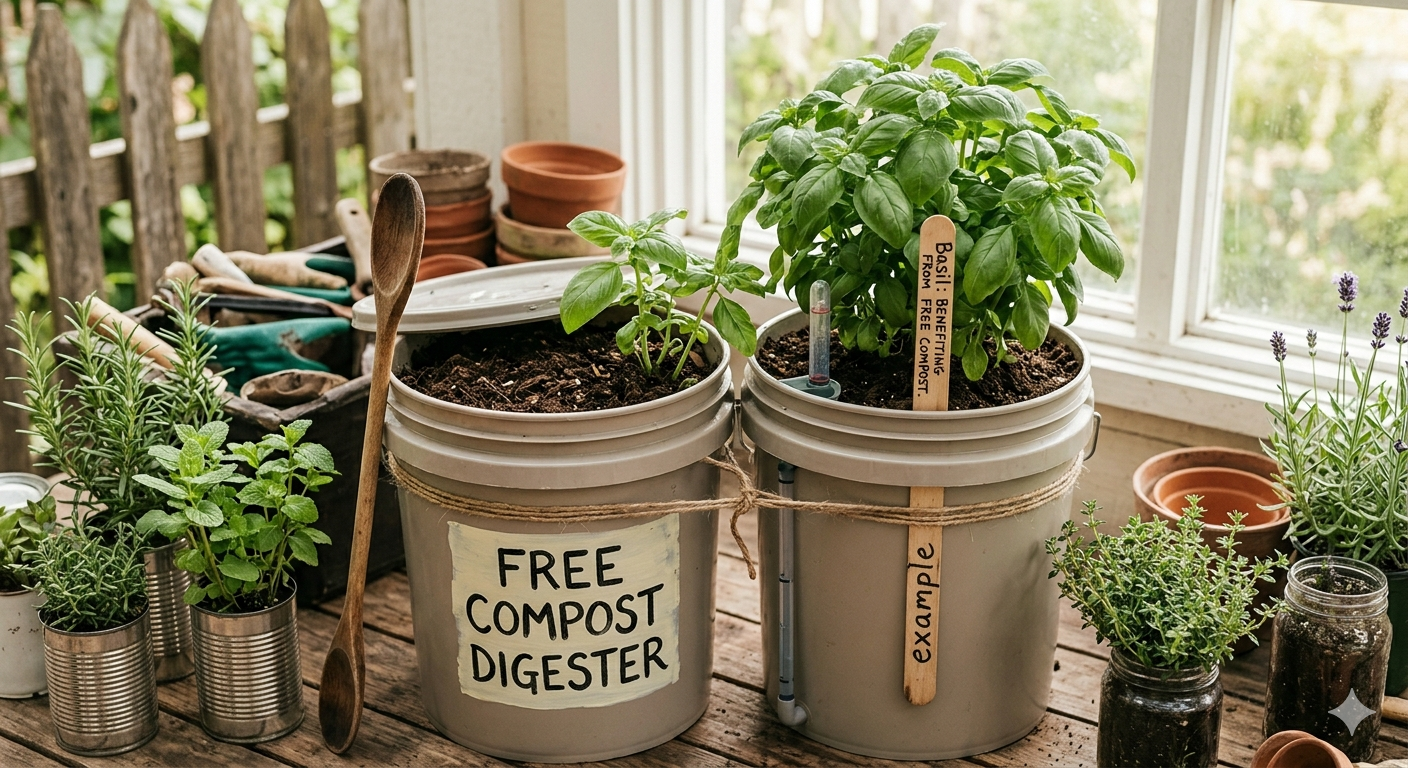
You don’t need a backyard to make compost, and you don’t need to keep handing over $10–20 every few weeks for a bag of fertilizer. If you’re growing a windowsill herb garden, a bucket of balcony tomatoes, or just a couple of houseplants, your kitchen scraps can become free, nutrient-rich plant food without ever leaving your apartment.
The whole setup is a 5-gallon bucket and a weekly routine that takes under 30 minutes. No smell, no mess, no special gear — just fertilizer made from things you were already throwing away.
❓ The problem: Herbs and balcony tomatoes need feeding, store-bought fertilizer runs $10–20 a bag, and most of what you’d need to make it yourself is already going in your trash.
👪 Who this helps: Apartment and balcony gardeners with a 5-gallon bucket and a small corner to spare.
✅ What you’ll learn: How to set up a bucket composter in 30 minutes, the two-bucket system that lets you keep adding scraps every day with no waiting, and how to pick between bokashi, worms, or aerobic composting based on what you actually cook.
💰 What you’ll save: Roughly $40–100 a year on fertilizer, plus you can stop buying potting soil once you’re producing your own compost.
🛠️ Your next step: Find an old 5-gallon bucket, drill 10–15 holes through the lid and sides, and start saving coffee grounds and vegetable scraps.
📅 Do this now: Scraps sent to landfill break down and release methane. The same scraps composted just feed your plants instead.
Which Method Fits Your Kitchen? (Bokashi vs. Worms vs. Aerobic)
Before you touch a drill, decide which of the three apartment-friendly composting methods actually matches how you cook and how much outdoor access you have. They all work indoors, but they handle different scraps and need different levels of follow-up.
| Ask yourself | If yes | If no |
|---|---|---|
| Do you regularly eat meat, fish, or dairy? | Go with Bokashi — the only method that safely handles those scraps | Move to the next question |
| Do you have any outdoor soil access (a balcony planter, a community plot, a friend’s yard) to bury fermented waste? | Bokashi still works, since it needs a burial step to finish | Skip Bokashi |
| Do you want a system that never requires burying anything outside? | Go with a worm bin — red wigglers live indoors year-round and the castings go straight into your pots | Move to the next question |
| Do you cook most days and want a $0 ongoing method? | Aerobic bucket composting — free, but the slowest of the three | Any method works — pick based on space |
The short version: Bokashi handles meat and dairy but needs somewhere to bury the finished ferment. Worm bins skip the burial step entirely but can’t process meat, dairy, or citrus. Aerobic buckets cost nothing and need no special supplies, but take the longest to finish.
| Method | Handles meat/dairy? | Needs outdoor burial? | Annual cost | Time to finished compost | Best for |
|---|---|---|---|---|---|
| Bokashi | Yes | Yes | $15–30 (bran refills) | 2–4 weeks ferment + 2 weeks in soil | Meat/dairy eaters with any outdoor soil access |
| Worm bin | No | No | $20–40 one-time | 2–4 months | Plant-based households with zero outdoor access |
| Aerobic bucket | No | No | $0 | 6–8 weeks | Anyone who wants a free, no-buy method |
In practice, the choice usually comes down to what’s actually in your trash can, not what a gardening blog recommends. A household eating chicken and cheese most nights needs Bokashi; worms simply can’t process those scraps. A mostly plant-based household with a sunny balcony can use either worms or an aerobic bucket.
When the Bucket Starts to Smell (And How to Fix It Fast)
A lot of composting advice promises “no smell at all,” which sets people up to panic the first time their bucket smells off. Here’s the more honest version: a working bucket smells like damp soil or, for Bokashi, something closer to pickles. Anything else is a signal, not a failure — and it’s usually fixable in minutes.
| What it smells like | What’s happening | How to fix it |
|---|---|---|
| Sour, like sauerkraut | Normal Bokashi fermentation | Nothing needed — add a bit more bran if it feels too strong |
| Ammonia / cat urine | Too many nitrogen-rich scraps, not enough carbon | Add shredded cardboard or dry leaves — roughly equal to the existing volume — and stir |
| Sulfur / rotten eggs | Too wet, not enough oxygen reaching the pile | Add dry browns and stir to reintroduce air; tip the bucket to drain if it’s dripping |
| Rancid, garbage-like | Meat or dairy in a non-Bokashi bucket | Remove it if you can; if the smell persists, discard the batch and start fresh |
| No smell, but cold | Too dry or too carbon-heavy | Add water gradually while stirring until it feels like a wrung-out sponge, plus a handful of coffee grounds |
Most apartment composters who give up do it after exactly one smell scare. Almost every case is fixable within about ten minutes, and a quick rescue tonight usually has things back on track by tomorrow.
The Coffee Ground Shortcut
Coffee grounds might be the single most useful thing you can add. They’re nitrogen-rich like fruit and vegetable scraps, but they arrive already broken down into fine particles with close to ideal moisture — microbes can get to work on them immediately.
- They introduce a large population of beneficial microbes right away.
- Their mild acidity helps break down tougher plant fibers faster.
- Residual caffeine appears to boost microbial activity — some studies suggest coffee grounds can speed decomposition by 20–30% compared to an equal weight of fruit scraps.
| Coffee grounds (share of bucket) | Effect |
|---|---|
| Under 10% | Mild benefit |
| 10–25% | Sweet spot — noticeably faster with no downside |
| 25–50% | Can tip into ammonia smell — balance with extra browns |
| Over 50% | Too acidic; can slow or harm worms — add crushed eggshells to buffer pH |
Free source tip: many coffee shops (including large chains through community give-away programs) hand out used grounds for free — call ahead, bring a container, and you can stock up weeks’ worth at no cost.
Adjusting for the Season
Apartment composting runs year-round, but how you manage it changes with the temperature.
When it’s hot indoors (85°F+): Microbes speed up and compost can finish in half the usual time — but faster isn’t automatically better. Excess heat can kill off beneficial microbes and even soften plastic bucket seals. Freezing scraps before adding them helps cool the bucket down and release moisture more gradually. Keep the bucket out of direct sun; even shade from a curtain helps.
When it’s cold indoors (60°F or below): Worms slow down noticeably below about 55°F, Bokashi fermentation stretches from 2 weeks to 3–4, and aerobic breakdown nearly stalls under 50°F. Moving the bucket to a warmer spot — near the fridge or under the kitchen sink, both of which run a little warm — helps. For worm bins, wrapping the bin in a towel adds a bit of insulation; for Bokashi, using about 20% more bran than usual keeps things moving.
Level Up: The Two-Bucket Continuous-Flow System
A single bucket has one annoying limitation — once it’s full, you have to stop adding scraps for 6–8 weeks while it finishes. If you cook daily, that’s a real problem. The fix is a two-bucket setup that costs under $10 and lets you add scraps every single day without ever pausing.
What you’ll need:
- Two food-grade 5-gallon buckets with lids (bakeries and delis will often give these away free)
- A drill with 1/4-inch and 1/8-inch bits
- A brick or a few stones
Building it (about 30 minutes):
- Drill the top bucket. Drill 20–30 quarter-inch holes in the bottom for drainage, plus 10–15 smaller eighth-inch holes around the top sides for airflow.
- Set up the bottom bucket. Leave it undrilled, and place a brick or stones inside to lift the top bucket slightly — this leaves room underneath for liquid to collect.
- Stack them. Nest the drilled bucket inside the undrilled one. The bottom bucket now catches any runoff — a free liquid fertilizer often called compost tea.
- Start layering. Add about 2 inches of shredded cardboard or dry leaves first (browns), then a 1-inch layer of kitchen scraps (greens), then another 1–2 inches of browns on top. Keep repeating this pattern.
- Do a weekly “lazy turn.” Once a week, lift the top bucket out and give it a gentle shake or roll on its side — keep the lid closed while you do this so the trapped heat and humidity aren’t lost.
- Harvest from the top. After 6–8 weeks, the oldest material at the bottom will be finished. Scoop from the top down, since finished compost naturally settles toward the bottom while newer material keeps processing above it.
This setup fits in the same footprint as one bucket, costs almost nothing extra, and produces a usable liquid fertilizer as a side effect — with no need to ever stop feeding it scraps.
Building Your First Aerobic Bucket (30 Minutes, $0)
If you don’t need to handle meat or dairy and don’t want to buy worms or bokashi bran, this is the simplest entry point.
What you’ll need: one clean, food-grade 5-gallon bucket with a lid; a drill with 1/4-inch and 1/8-inch bits; shredded newspaper or cardboard; kitchen scraps; and, optionally, a handful of garden soil or finished compost to jump-start the process.
- Prep the bucket. Drill 10–15 small holes in the lid for airflow, and another 10–15 in the bottom for drainage.
- Lay the base. Fill the bottom 2–3 inches with shredded cardboard or newspaper to soak up excess liquid and add carbon.
- Add your first scraps. Layer in about 2 inches of chopped vegetable peels, coffee grounds, and eggshells — smaller pieces break down faster.
- Cover with browns. Add another 2 inches of shredded paper or cardboard over the top, making sure no food scraps are left exposed.
- Moisten lightly. Spray with water until the contents feel like a wrung-out sponge — damp, not dripping.
- Repeat and wait. Keep alternating greens and browns until the bucket is about three-quarters full, stirring once a week. It’s ready when it looks like dark, crumbly soil — usually 6–8 weeks.
Putting Finished Compost to Use
Once it looks dark, crumbly, and smells like earth, it’s ready to use.
| Plant type | How to apply it | Amount |
|---|---|---|
| Windowsill herbs | Mix into the top 1–2 inches of potting soil | 1–2 tablespoons per 6-inch pot |
| Balcony tomato bucket | Top-dress around the base of the stem | ¼–½ cup per bucket, once a month |
| Houseplants | Sprinkle on the soil surface and water in | 1 tablespoon per 6-inch pot |
| Seed-starting mix | Blend into potting soil | 1 part compost to 4 parts soil |
One important caution: never apply unfinished compost directly to plant roots — the excess nitrogen can burn them, and it may still carry pathogens. If it still smells sour or has visible food pieces, give it another 2–4 weeks.
If you’re already growing new plants from grocery-store scraps, adding your own compost closes the loop — scraps feed the plants, the plants feed you, and very little goes to waste.
Mistakes That Derail Apartment Composting
- Adding meat, dairy, or oily food to an aerobic or worm bucket. These cause rancid smells, attract pests, and can kill worms outright. Bokashi is the only method built to handle them.
- Overwatering. A soggy, waterlogged bucket goes anaerobic and starts smelling like rotten eggs. If you can squeeze liquid out of a handful, add dry browns right away.
- Skipping the browns. Too many scraps and not enough carbon-rich material causes ammonia smell. Aim for roughly twice as much browns as greens by volume.
- Sealing an aerobic bucket completely airtight. These systems need airflow — drill holes or leave the lid slightly cracked.
- Quitting after one bad batch. Nearly every apartment composter deals with a smelly week or a fruit-fly moment at some point. The fix is almost always more browns, more air, and less water — not starting over from scratch.
Myth vs. Reality
| Myth | Reality |
|---|---|
| Apartment composting always smells bad. | A properly balanced bucket smells like damp soil or pickles. A bad smell is a fixable signal, not the default. |
| You can’t compost meat or dairy indoors. | Bokashi handles meat, fish, dairy, and cooked food without issue — it’s built for exactly that. |
| You need expensive gear to start. | A free bucket, a drill, and kitchen scraps cover the basics. Worms and Bokashi bran are optional add-ons, not requirements. |
| Composting needs a yard. | Some of the smallest working setups fit under a kitchen sink. Whatever space you have is probably enough. |
| You have to turn it daily. | Once a week is plenty for aerobic and worm systems. Bokashi needs no turning at all — just drain the liquid every few days. |
FAQ
Will my compost bucket attract bugs or rodents?
Not if food scraps stay buried under a layer of browns and the lid stays on. Exposed scraps draw fruit flies, so always cover fresh additions — and keep meat or dairy out of non-Bokashi systems entirely.
How long until I get my first usable batch?
Aerobic buckets take about 6–8 weeks. Bokashi takes 2–4 weeks to ferment plus roughly 2 weeks buried in soil to neutralize — so 4–6 weeks total. Worm bins take the longest, usually 2–4 months for a first harvest, but also produce liquid fertilizer along the way.
Can I compost without drilling any holes?
Yes — that’s exactly how Bokashi works. A sealed bucket creates the oxygen-free environment fermentation needs. Aerobic composting is the opposite: holes are essential for airflow and drainage.
What’s the liquid that collects at the bottom?
That’s compost tea — a free liquid fertilizer. Dilute it about 1:10 with water before using it on plants. Bokashi liquid can also be poured down drains as a mild cleaner.
My bucket is full — what now?
Stop adding new scraps and let that batch finish over the next 2–4 weeks. Starting a second bucket while you wait is exactly why the two-bucket rotation exists.
Cutting Even More Kitchen Waste
Composting handles what’s left over, but you can prevent food waste in the first place with free AI prompts for turning fridge scraps into meals before vegetables even reach the compost bucket. Between smarter meal planning and bucket composting, almost nothing from your kitchen has to end up in a landfill.
Written by Sharjeel — Founder, informix.today
Last updated: July 2026
Disclaimer: This article is for general informational purposes only and isn’t professional agricultural, environmental, or health advice. Results vary based on local climate, scrap composition, and how consistently the routine is maintained.